

12 Jun Running or clumping bamboo
what are the differences and risks?
Bamboo is a plant particularly valued for its rapid growth, evergreen foliage, and ability to quickly create a natural screen. However, not all bamboos behave in the same way.
Before planting, it is essential to understand the difference between running bamboo and clumping bamboo. This distinction directly determines how the plant will develop in your garden over the years.
Many invasive problems originate from a lack of understanding of this fundamental difference.
A very common misconception is to think that clumping bamboos are completely harmless. In reality, even though they generally present fewer risks than running species, they too can become problematic when planted in the wrong location or left without maintenance for many years.
How does bamboo grow?
Unlike many shrubs, bamboo develops through an underground network called a rhizome.
The rhizome is an underground stem that stores the plant’s energy reserves and allows it to produce new culms at a distance from the original clump.
It is this underground system that explains the rapid development of certain species.
Depending on the type of bamboo, rhizomes can remain clustered around the plant or travel several meters underground.
It is this characteristic that distinguishes running bamboos from clumping bamboos.
What is running bamboo?
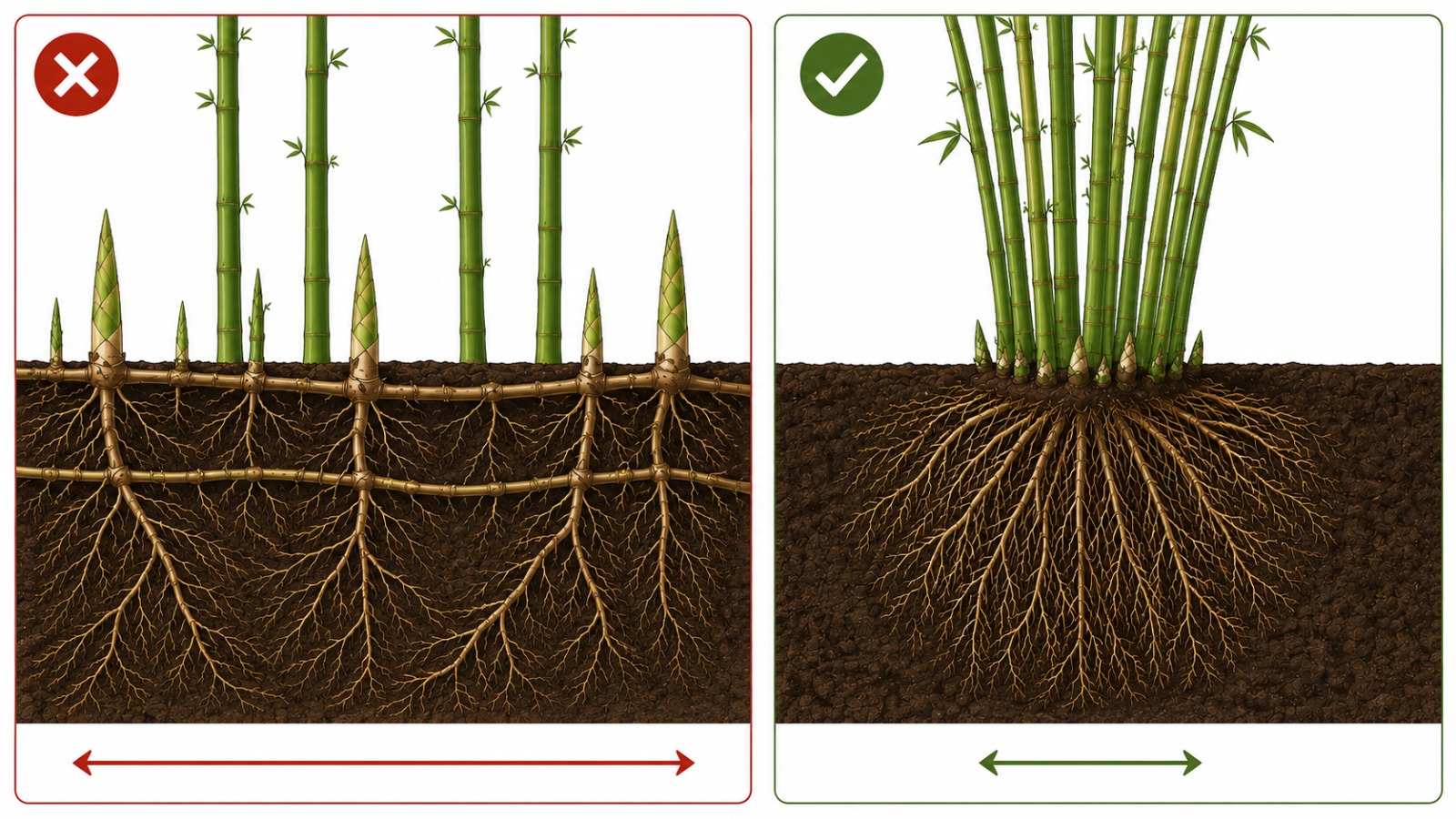
Running bamboos develop horizontal rhizomes capable of progressing rapidly through the soil.
These rhizomes regularly produce new culms sometimes several meters away from the original planting.
When they have sufficient space and favorable conditions, they can gradually colonize a large portion of the land.
Characteristics of running bamboos
- Very rapid growth.
- Strong expansion capacity.
- Production of new culms at a distance.
- Need for regular control.
- Recommended installation of a rhizome barrier.
Most common running species
Phyllostachys aurea
Probably one of the most planted bamboos in gardens.
Very attractive, it also has a significant propagation capacity.
Phyllostachys nigra
Recognizable by its black culms, it is particularly valued for its decorative appearance but also develops running rhizomes.
Phyllostachys bissetii
Robust and cold-resistant species, often used to create privacy hedges.
Phyllostachys vivax
Giant bamboo that can reach several meters in height and develop a particularly extensive rhizome network.
Pseudosasa japonica
Very common in older landscaping, it is often the source of significant invasions observed several years after planting.
What is clumping bamboo?
Clumping bamboos develop short rhizomes that remain clustered around the main clump.
The plant gradually expands but theoretically maintains a more compact form than running species.
This characteristic often leads homeowners to think they can be planted without special precautions. However, this view is sometimes misleading.
Even though clumping bamboos generally do not travel several meters underground, their clump continues to grow year after year. Some clumps become extremely dense and can reach significant dimensions after just a few years.
We regularly work in gardens where Fargesia or other clumping bamboos have been installed too close to:
- a patio;
- a low wall;
- a fence;
- an edging;
- a staircase;
- a pathway;
- a retaining wall.
Over time, the pressure exerted by the clump can cause deformations, cracks, or displacement of certain structures.
The problem is often underestimated because it appears slowly. For several years, the bamboo seems perfectly controlled before the clump becomes much larger than expected.
Characteristics of clumping bamboos
- Clump development.
- Slower expansion than running species.
- Low risk of colonization at a distance.
- Sometimes very significant growth in width.
- Dense and powerful clump over the years.
- Need to provide sufficient space around the planting.
The Fargesia genus
Fargesia is the best-known representative of clumping bamboos.
There are many varieties suitable for Belgian and French gardens:
- Fargesia rufa
- Fargesia robusta
- Fargesia nitida
- Fargesia murielae
- Fargesia jiuzhaigou
These varieties are often recommended for creating hedges because they do not develop long invasive rhizomes.
However, this does not mean they are without constraints. Some varieties can form very wide and very dense clumps.
Can clumping bamboo become invasive?
This is a common question.
The answer is yes, but in a different way than running bamboos.
Clumping bamboo does not have the same propagation capacity as a Phyllostachys or Pseudosasa. It will generally not send shoots several meters away into a neighboring garden.
However, it can become invasive through its volume.
A Fargesia clump left without maintenance for many years can occupy considerable space and make access to certain areas of the garden difficult. In small spaces, it can quickly become disproportionate to the initial layout.
The major difference is that this expansion remains concentrated around the planting point.
How to recognize running bamboo?
Several clues can help:
- Appearance of new shoots far from the main clump.
- Presence of bamboo under the lawn or in neighboring beds.
- Development under fences.
- Spread onto neighboring properties.
Observation of the rhizomes generally allows rapid identification:
- Long and horizontal rhizomes: running bamboo.
- Short and clustered rhizomes: clumping bamboo.
Why do running bamboos sometimes cause problems?
When not controlled, rhizomes can develop under:
- Lawns.
- Beds.
- Hedges.
- Fences.
- Patios.
- Pathways.
- Parking areas.
- Neighboring properties.
The majority of interventions we carry out involve running bamboos planted several years earlier without appropriate control measures.
Which solution to choose before planting?
The choice depends mainly on the desired objective.
For a garden requiring little maintenance, Fargesia generally remain easier to manage than running bamboos. However, they should not be considered plants without constraints.
Before any planting, it is recommended to check:
- the mature width of the chosen variety;
- the proximity of structures;
- the presence of edgings or low walls;
- the space actually available in the long term.
For those wishing to enjoy the aesthetic qualities of Phyllostachys, it is strongly recommended to plan from the outset a professional rhizome barrier installed according to best practices.
Our expert opinion
Bamboo is not a bad plant. Most problems simply come from a poor choice of species or lack of planning during planting.
It is important to remember that clumping bamboo is not necessarily risk-free bamboo. While it generally does not colonize the land like running bamboo, it can still become very large and cause problems when installed too close to sensitive structures.
Understanding the difference between running bamboo and clumping bamboo helps avoid the majority of problematic situations observed in gardens.
Before any planting, it is essential to assess the available space, site constraints, and desired objectives in order to select the most suitable species and plan for its development over several decades rather than just a few years.
No Comments